Build a Real Business With AI — No Tech Skills Required
The plain English guide for people who know their stuff but don't know where to start
Hey,
Let me clear something up before we go any further.
Building an online business in 2025 does not require technical skills. It doesn't require coding, web development, design experience, or any understanding of how any of it works under the hood.
What it requires is knowledge worth sharing, willingness to use a small number of simple tools, and the consistency to show up every day.
If you have those three things — and you do — here's the complete picture.
The 5 Things Your Business Needs and the Simplest Tool for Each
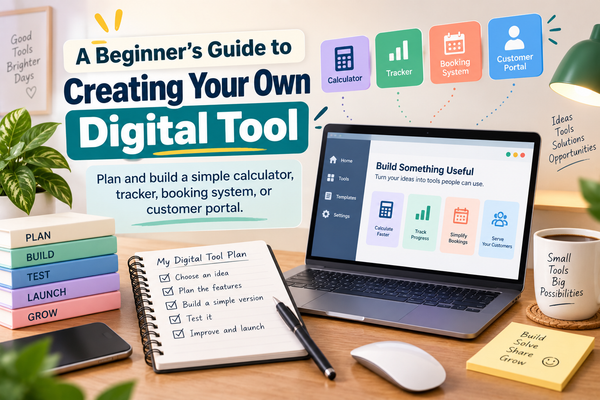
1. Your Product → ChatGPT (free)
Go to chat.openai.com. Create an account. Type this:
"I have experience in [your background]. I want to help [your audience] with [their problem]. Give me five digital product ideas and a complete outline for the strongest one."
Read what comes back. Pick the idea that feels most true to what you actually know. Ask ChatGPT to expand every section into full written content.
Edit it. Add your stories. Add your examples. That combination of AI structure and your lived experience is the product.
No writing degree required. No blank page staring contest. Just a conversation with a tool that does the heavy lifting so you can focus on adding the parts only you can provide.
2. The Design → Canva (free)
Go to canva.com. Search "PDF guide" or "workbook." Pick a clean, professional template. Replace the placeholder text with your content. Download as PDF.
That's it. Genuinely, that's the entire design process.
The templates were made by professional designers. You're using their work as your starting point. Your product will look polished and credible without you touching a single design setting beyond the text.
3. The Sales Page → Gumroad (free)
Go to gumroad.com. Create an account. Upload your PDF. Write a description using this ChatGPT prompt:
"Write a product description for [product title]. It's for [audience]. Before they buy, they struggle with [problem]. After using it, they will [specific result]. Open with the problem, introduce the product as the solution, list five outcome-focused benefits, and close with a clear call to action. Under 250 words."
Set your price. Hit publish. Anyone in the world can now find your product, pay for it, and receive it automatically — without you doing anything.
4. Your Email List → Ghost (free)
Go to ghost.org. Set up a subscribe page. Offer a free resource — a checklist, a one-page guide, the introduction section of your product — in exchange for an email address.
Put the subscribe link in your social media bio. Every person who downloads your free resource enters your world. Your email list is the only audience you truly own — every social platform can limit your reach overnight. Your list cannot be taken from you.
5. Your Content → ChatGPT plus your platform of choice
Once a week, open ChatGPT and type:
"I help [audience] with [topic]. Write three social media posts: one educational, one that asks a genuine question my audience wrestles with, and one that shares a personal lesson. Optimise for [your platform]. Under [character limit] characters each."
Edit each post for your voice. Add a specific example only you would know. Post three times this week. Repeat next week.
That consistency — not virality, not perfect content, not a massive following — is what builds an audience that eventually buys from you.
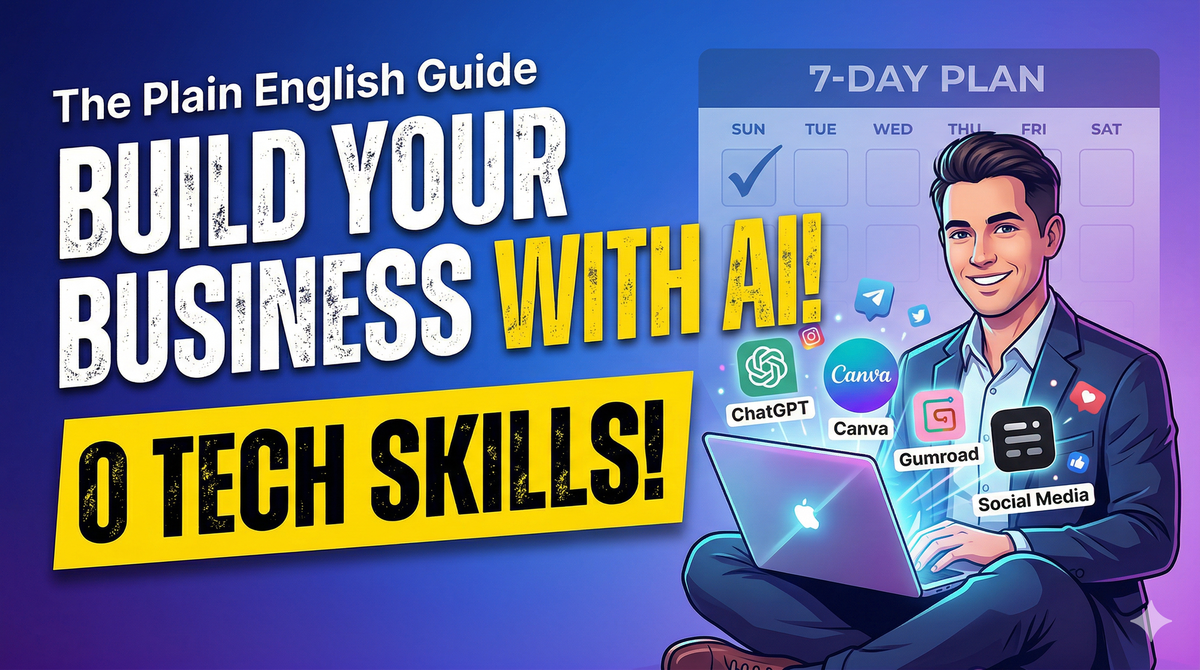
The 7-Day Build Plan
Here's what the first week looks like with all five components running:
Monday: Run the ChatGPT product prompt. Land on one idea. Get the full outline.
Tuesday: Expand every section into written content. Edit it. Add your voice and your stories.
Wednesday: Open Canva. Design the PDF. Download it.
Thursday: Set up Gumroad. Write your product description with AI. Publish it. Your product is live.
Friday: Write three pieces of content with ChatGPT. Post the first one. Schedule the other two.
Saturday: Set up Ghost. Create your lead magnet. Add the link to your bio.
Sunday: Post about your product publicly. Send ten personal messages to people in your network who face the problem it solves.
Total time: approximately eight hours. Total cost: £0. Technical knowledge required: none.
By Sunday night you have a live product, an email list, content published, and real people in conversation about buying.
The Three Questions People Always Ask
"What if it's not good enough?"
It doesn't need to be perfect. It needs to be useful. Ship it, collect real feedback from real buyers, and improve it. Every creator you admire has a first product they'd do differently now. That product is what taught them how.
"What if nobody buys it?"
Either the offer needs sharpening — more specific problem, clearer outcome — or not enough people have seen it yet. Both are fixable. Neither means stop.
"What if AI writes something wrong or generic?"
It will, sometimes. That's why you read everything before you publish it. AI writes the first draft. You are the editor, the quality check, and the final authority. Never skip that step.
The Simple Truth Underneath All of This
The tools build nothing on their own.
They remove the technical barriers that used to stand between your knowledge and the people who need it. They collapse timelines. They give you a starting point instead of a blank page.
But the business is built by you — showing up consistently, with genuine knowledge, for a specific person with a specific problem.
The tools are ready when you are.
This week's action: Open ChatGPT tonight. Run the product idea prompt. Come back with one idea and an outline. That's Day One done.
Reply and tell me what you came up with — I read every response and I'll give you honest feedback on whether it's worth building.
PJ