The 7 hooks that stop the scroll every time
Hey,
Let me ask you something uncomfortable.
Think about the last piece of content you posted. The post you spent twenty minutes crafting. The one you were genuinely proud of when you hit publish.
Now honestly — how many people read past the first two lines?
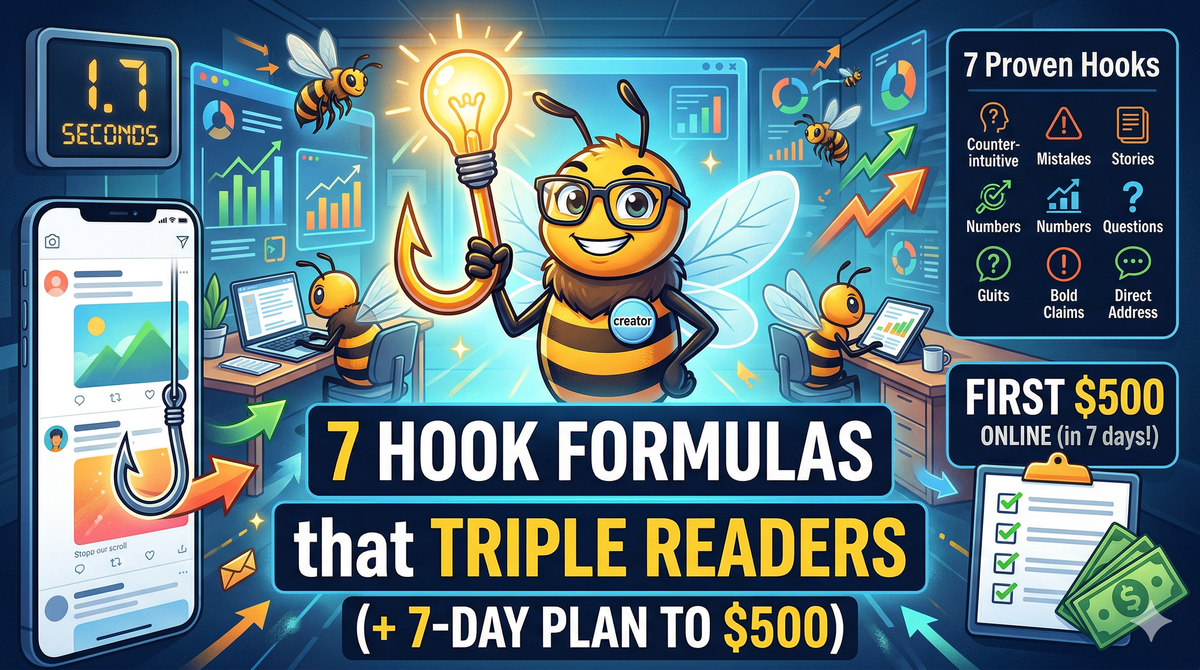
For most social media content, the answer is somewhere between uncomfortable and devastating. Studies consistently show that the majority of people who see a post on any platform never read past the first sentence or two. The algorithm shows your post to a small initial audience. Those people spend an average of 1.7 seconds deciding whether to keep reading or scroll.
1.7 seconds.
Everything — the insight you spent time developing, the story you carefully crafted, the tactical advice your audience genuinely needs — all of it depends entirely on whether those first seven words earn the next seven.
That's not a content problem. It's a hook problem.
And today we're fixing it permanently.
Why the Hook Is Everything
The hook is not a clever trick you add to make your post pop. It's the fundamental architecture of content that gets read.
Here's the chain reaction a great hook sets off:
A strong first line creates enough curiosity, resonance, or surprise that the reader stops scrolling and reads the second line. A strong second line earns the third. By the time they've read five lines, they're committed — the psychological investment means they're likely to finish.
But if the first line doesn't earn the second? The rest of your content doesn't exist. It's invisible. Not because it's bad — but because nobody got far enough to find out.
This is why two posts with identical content can perform completely differently. The one with the better hook gets read. The other one doesn't.
Here are the seven hook formulas I use and teach — each one built on a different psychological principle, each one reliably effective across every platform.
Hook Formula 1 — The Counterintuitive Claim
Psychological principle: Cognitive dissonance. We're wired to stop and examine things that contradict what we believe to be true.
Structure: "[Common belief everyone holds] is actually [opposite of what they expect]."
Examples:
- Charging more for your course will increase your conversion rate.
- Posting less often will grow your audience faster.
- The most important page on your website is not your homepage.
The key: the claim must be genuinely counterintuitive — not just edgy for its own sake — and you must be able to back it up convincingly. A counterintuitive claim you can't support destroys trust. One you can support builds it exponentially.
Hook Formula 2 — The Specific Number
Psychological principle: Specificity creates credibility. Vague promises feel like marketing. Precise numbers feel like truth.
Structure: "[Specific number] things I wish I knew before [relevant milestone or experience]."
Examples:
- 7 things I wish someone had told me before I launched my first course.
- 3 pricing mistakes that cost me $14,000 in my first year of selling info products.
- 11 words that doubled my email open rate overnight.
Notice what happens with the third example. "11 words" is so specific that disbelieving it takes more effort than reading it. Specificity earns attention.
Hook Formula 3 — The Mistake Reveal
Psychological principle: Fear of loss. We're more motivated to avoid mistakes than to achieve gains. Showing someone a mistake they might be making activates immediate attention.
Structure: "Stop doing [common behaviour]. Here's why it's quietly hurting your [outcome]."
Examples:
- Stop writing your email subject lines last. Here's why it's hurting your open rates.
- Stop selling your course in your content. Here's why it's costing you followers.
- Stop pricing your products based on how long they took to create. Here's what to price them on instead.
The best version of this formula: the mistake should be something your ideal reader is almost certainly doing right now. The more universally applicable, the higher the stop rate.
Hook Formula 4 — The Story Opener
Psychological principle: Narrative transportation. The moment we identify a story beginning, our brains shift into a different mode of attention — one that's harder to interrupt.
Structure: "[Specific time period] ago, I [specific situation]. Here's what changed everything."
Examples:
- Fourteen months ago, I had 89 email subscribers and had made exactly $0 online. Here's what the next twelve months looked like.
- Three years ago, I was charging $25 an hour for my consulting. Here's the moment I understood I had the pricing completely backwards.
- Six months ago, I couldn't write a social media post without spending an hour staring at a blank screen. Here's the system I use now.
The specificity of the time period does a lot of work here. "A few years ago" is forgettable. "Fourteen months ago" is oddly precise in a way that feels honest and trustworthy.
Hook Formula 5 — The Question That Demands an Answer
Psychological principle: Open loops. An unanswered question creates genuine cognitive tension that the brain wants to resolve.
Structure: "What if [commonly accepted assumption] was completely wrong?"
Examples:
- What if you don't need a big audience to make $5,000 a month from info products?
- What if the reason your content isn't converting has nothing to do with your content?
- What if the product you should build first isn't the one you're most excited about?
The test for this formula: does the question create a genuine "huh, I wonder" response? Or does it feel rhetorical and obvious? Only genuine curiosity earns the click.
Hook Formula 6 — The Bold Claim With Proof Promised
Psychological principle: Sceptical intrigue. A bold claim alone triggers resistance. A bold claim paired with a promise of evidence triggers curiosity.
Structure: "[Surprising or controversial statement]. Here's the proof."
Examples:
- Most online courses fail not because of bad marketing — but because of the checkout page. Here's the data.
- The free version of your product is costing you more sales than it's generating. Here's why.
- Your best-performing content this year will probably be something you almost didn't post. Here's the pattern.
The "here's the proof" ending is crucial. Without it, the bold claim is just an opinion. With it, you've created an implicit contract to deliver evidence — which the reader needs to see.
Hook Formula 7 — The Direct Address
Psychological principle: Personal relevance. Nothing breaks through noise like feeling personally called out — in the best possible way.
Structure: "If you're a [specific person] struggling with [specific problem] — this is for you."
Examples:
- If you're a coach who knows you should be selling digital products but can't figure out where to start — this is for you.
- If you've been building your audience for six months and still haven't made your first sale — read this carefully.
- If you've created a product that isn't selling and you're not sure why — the answer is almost certainly in this post.
This formula works best when the description is uncomfortably specific. The more precisely you describe your ideal reader's exact situation, the more they feel like this content was written specifically for them — because it was.
Applying the Formulas: The AI Hook Generator
Here's how to use AI to generate and test hooks at scale:
"I'm writing a post about [your topic] for [your audience]. The main insight I'm trying to communicate is [one-sentence description]. Using each of the following seven hook formulas, write one hook variation: (1) Counterintuitive claim, (2) Specific number, (3) Mistake reveal, (4) Story opener, (5) Question that demands an answer, (6) Bold claim with proof, (7) Direct address."
You now have seven opening lines for the same post. Read them. Pick the one that makes you think: I would stop scrolling for that. That's the one you use.
Then — one week later — run it again with a different angle and test the new variation. Over ninety days of testing, you'll develop an intuitive understanding of which hook types your specific audience responds to most.
That intuition is a business asset.
Go Deep, Not Wide: Why Your Niche Is Your Superpower
While we're talking about content — let's talk about something that affects every hook you'll ever write, every product you'll ever build, and every sale you'll ever make.
Your niche.
The most common fear I hear from knowledge creators — even experienced ones — is some version of: "What if my niche is too small?"
It's the wrong question. Let me give you the right one.
The right question is: "Is my niche specific enough that the right person immediately recognises themselves when they read my content?"
If the answer is yes — your niche is fine. In fact, your niche might be the most powerful asset in your business.
Here's why.
When you're specific enough, something remarkable happens. Your content doesn't just attract anyone interested in your broad topic — it attracts the exact person who needs exactly what you offer. And that person doesn't comparison-shop. They don't weigh your course against seven others. They find you and think: this person is speaking directly to my situation.
That recognition is worth more than any marketing tactic, hook formula, or launch strategy in existence.
The path from generic to ownable looks like this:
"I help people with social media" → "I help coaches grow on social media" → "I help life coaches attract clients through LinkedIn without running ads" → "I help newly certified life coaches land their first three paying clients through LinkedIn in ninety days — using a content system that takes under one hour a day"
At that final level of specificity, you don't have competitors. You have a category.
Your content hooks become easier to write because you know exactly who you're writing for. Your product becomes easier to sell because it solves a precisely named problem for a precisely identified person. Your positioning becomes your marketing.
Go deeper. You'll never regret it.
The 7-Day Plan to Your First $500 Online
I want to close today with something practical for anyone who hasn't yet made their first online sale — or who wants to repeat the experience faster.
This is a tested, seven-day action plan. It requires no existing audience, no paid ads, no complex technology, and no product that isn't already at least roughly built.
It requires honesty, consistency, and the willingness to have real conversations with real people.
Day 1 — Define the problem
Write this sentence: "[Specific person] struggles with [specific problem] and wants [specific result]."
This is your product brief. Everything else flows from here.
Day 2 — Create the solution
Use AI to build a 10–15 page PDF guide walking through your solution. Use the lead magnet anatomy from yesterday. Export from Canva.
This is your product. Done in one day.
Day 3 — Set up the sale
Create a free Gumroad account. Upload your PDF. Write a transformation-first description (outcome first, features second). Price it between $37 and $67. Add a cover image. Publish.
Your product is for sale. You spent no money.
Day 4 — Post about the problem
Write one post on your primary platform describing the problem your PDF solves. No mention of the product. Just empathy and insight. End with: "Is this something you're currently dealing with?"
Day 5 — DM your warm audience
Take yesterday's engagement and turn it into conversations. Send fifteen personal messages to people who responded, people who've engaged with your previous content, and people in your network who face this problem.
Script: "Hey [name] — I just finished building [product]. It solves [problem]. Given what you mentioned about [reference their situation], I genuinely think it would help you. Want me to send the link?"
Day 6 — Follow up
Message anyone from Day 5 who hasn't responded. "Hey — did you get a chance to see that? Happy to answer any questions."
Day 7 — Sell publicly
Post directly about your product. Transformation-first framing. Real, honest, specific. "I created [product name] for [audience]. If [specific problem] sounds like your situation, here's the link: [link]. Honest question — would this help you right now?"
At $47, you need eleven buyers.
Eleven people out of everyone you know, everyone who follows you, and everyone you reach out to personally.
That is not a big number. It is a very achievable number for someone willing to execute this plan with intention.
The first $500 online changes something. Not just in your bank account — in your belief. And belief is the fuel that builds everything that comes after.
Go get it.
Today's Action Steps
For your content: Take one topic you've been meaning to post about and run the AI hook generator prompt above. Generate all seven variations. Pick the strongest. Post it today.
For your niche: Write out your current positioning statement and push it one level deeper using the specificity ladder above. If you can go deeper — go deeper.
For your first $500: If you haven't made your first online sale yet — start the seven-day plan today. Day 1 takes fifteen minutes. Do it before you sleep tonight.
Tomorrow we're talking about the content calendar — how to plan an entire month of content in one afternoon using AI, why the creators who "always have something to post" are working from a system, not inspiration, and the imposter syndrome reframe that's given more of my students permission to start than any mindset book ever has.
See you then.
PJ
P.S. — Which of the seven hook formulas felt most natural for your voice and your audience? Reply and tell me. I'm genuinely curious whether certain niches gravitate toward certain hooks — and your answer helps me build better content for everyone in this series.