Make Your Free Hours Worth as Much as Your Working Ones — Here's How
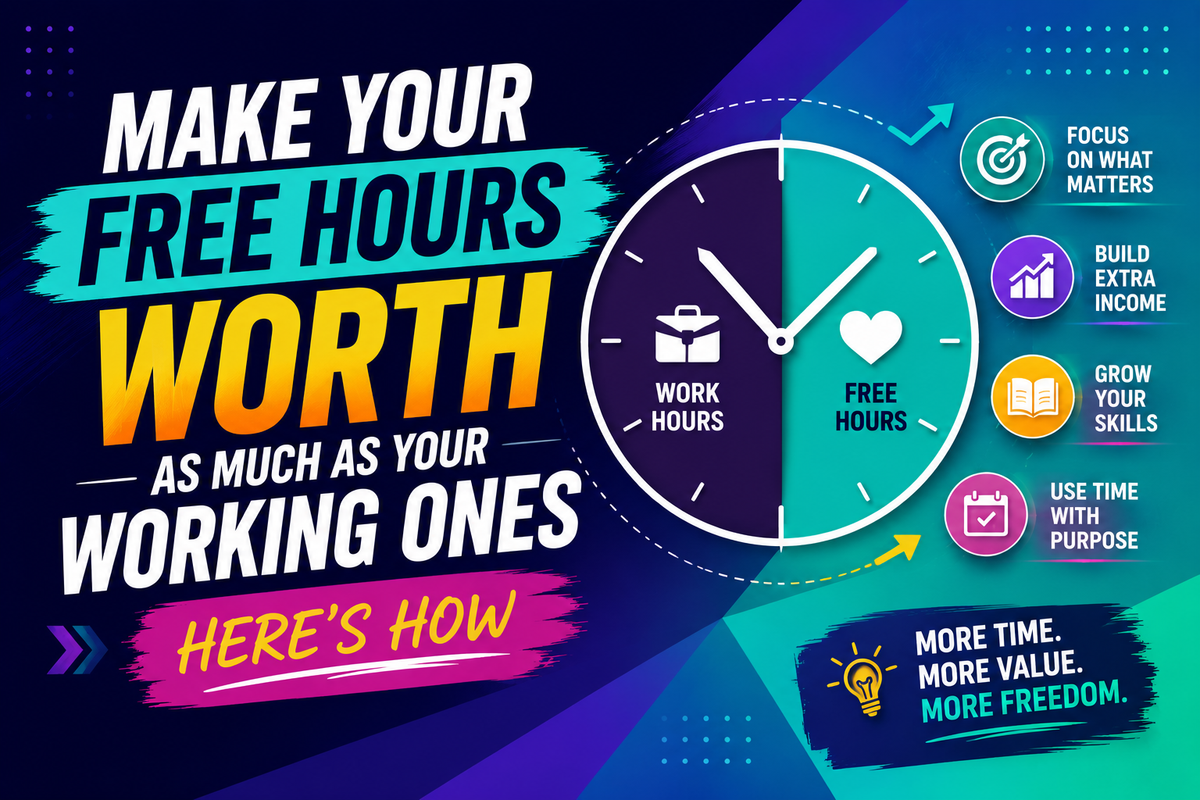
You'll never match a full week's pay by adding evenings. Here's the arithmetic that shows what to change instead.
Start with a number most people have never actually worked out.
Take what you earned last year and divide it by the hours you genuinely gave it — the commute, the evening email, the Sunday afternoon that never quite belonged to you. That figure is what an hour of your time currently earns.
Hold onto it. Everything below is about beating it.
Free time can't compete on hours. It has to compete on rate.
A working week is forty hours. Free time, honestly counted, is eight or ten — and those are the tired ones.
You will never match a full-time wage by working more evenings. The arithmetic simply doesn't allow it, which is why so many people grind for a year and conclude the whole idea doesn't work.
To match a day's pay inside a spare hour, that hour has to be worth several times more. That's a pricing problem, not an effort problem.
Three things change what a spare hour is worth.
Sell the narrow thing, not the general one. General work competes with everybody and gets priced accordingly. The specific thing your job made you unusually good at has a rate the crowd doesn't set. Same hour, different number.
Sell the same work more than once. A template, a guide, a process someone buys without you delivering it again. Ten hours spent building something that sells thirty times stops resembling wages entirely — and it's the only version of this that keeps paying on the weeks you're too tired to work.
Cut the production time instead of the price. This is where the tools genuinely move the maths. Drafting, research, formatting, the first version of anything. If a job that took six hours now takes two, your effective rate tripled without a single awkward conversation about money.

Now the honest part, because this is where people go wrong.
● Expect it in stages. First it covers a bill. Then a car payment. Then a meaningful share of a month. Treating stage one as failure is what makes people quit six weeks before it gets interesting.
● Price the outcome, not the hour. Free time sold by the hour stays a second job forever. Sold by what it's worth to the person buying, it stops being one.
● Raise the rate before adding hours. More hours cost you evenings you don't have. A higher rate costs one uncomfortable sentence in an email.
● Let the salary fund the patience. A wage covering the bills is what lets you decline the badly paid work that would otherwise eat the entire experiment.
Nobody matches a full-time income in a fortnight, and anything promising that is selling something. But eight good hours a week, priced properly and sold more than once, gets there far sooner than eight hours priced like overtime.
Work out your hourly figure this weekend. It takes five minutes and it's the only number this whole thing depends on.
Your spare hours were never worth less than your working ones. They've just never been priced.
— AI Business Builder