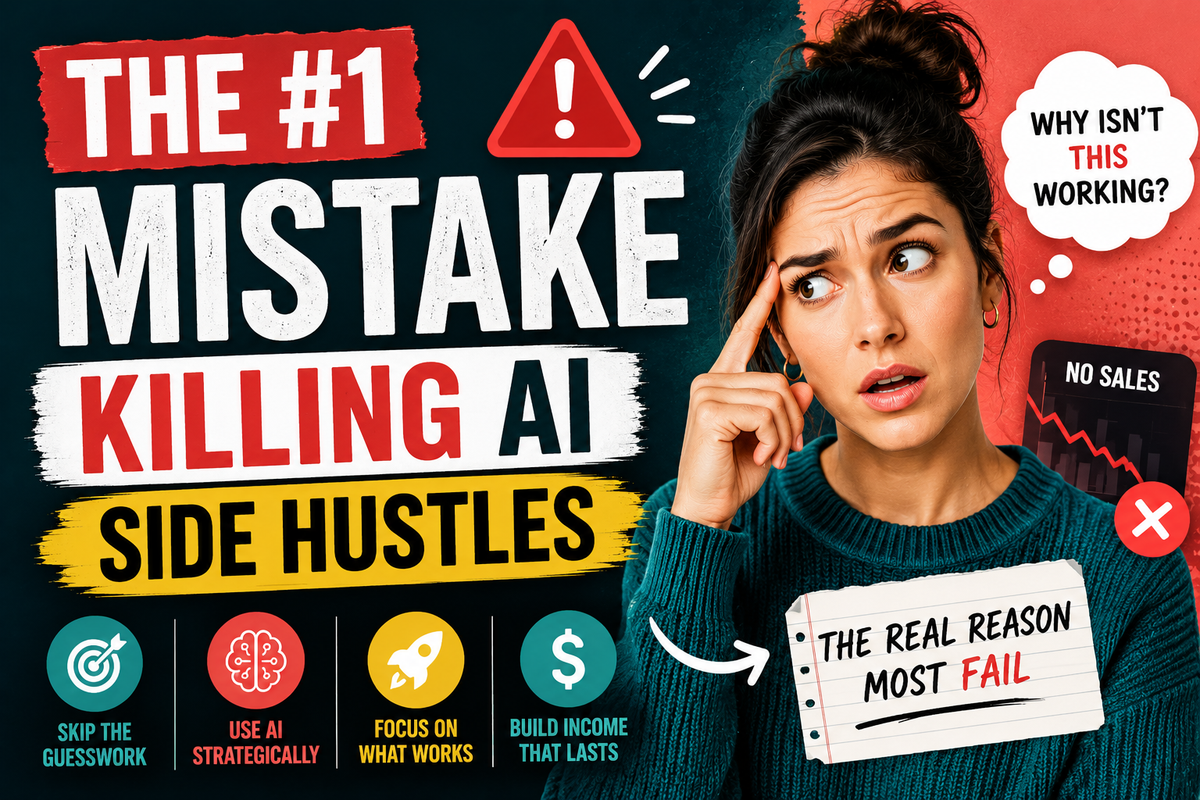
The #1 mistake killing AI side hustles
I've been in this space long enough to see patterns.
And the pattern I see most — the one that kills more AI side hustles than anything else — is something that sounds responsible. It sounds like preparation. It even sounds smart.
But it's actually the most expensive trap in the game.
It's building a product nobody asked for.
And I see it happen every single week.
The story most people know
You get an idea. A good one. It hits you in the shower or during your commute and you think — yeah, I could build this. People need this.
So you open ChatGPT. You write an outline. Then another. You spend four evenings writing the content, two more designing it in Canva, another afternoon setting up Gumroad with a custom domain and branded checkout page.
You record a little intro video. You write a launch email. You write the subject line six times.
Then you hit publish.
And nothing happens.
Not "a few slow sales." Not "disappointing traction." Nothing. The sound of absolute silence from a market that was never consulted.
You've just invested 60+ hours into something the market doesn't want. This is the mistake. And it's not rare — it's practically universal among first-time digital product creators.
Getting a side hustles does not need to be too difficult:
5 signs you're about to make this mistake
Before you open Canva for your next product, check this list honestly:
- You came up with the idea yourself, without asking anyone what they actually needed
- Your product is based on what YOU would have wanted — not on something someone has asked you for directly
- You've talked about your product to zero potential buyers before starting to build
- You're spending more time on design and formatting than on whether anyone even wants the content
- Your "market research" was Googling whether similar products exist — not talking to actual humans
If 3 or more of those apply → stop what you're building right now.
Not because the idea is bad. Because you don't know yet whether it's good.
You should always be looking for how to use ai to create a side hustle
The math that makes this so expensive
Here's why this mistake hurts so much more than it seems like it should:
The expected cost of skipping validation isn't "a bit of wasted time." It's 40–80 hours multiplied by a 70% probability of failure — that's 28–56 wasted hours on your very first attempt.
And more than the time, it's the discouragement. Most people don't try again after a failed launch. They decide "this doesn't work" — when what actually didn't work was the sequence, not the method.
The fix: sell it before you build it
The rule that changes everything:
Never spend more than 5 hours on a product idea until at least one person has confirmed they'd pay for it.
That's the whole rule. It sounds too simple to be worth saying. It is not.
Here's what "confirmed they'd pay for it" actually looks like in practice:
They've said the words "yes I'd buy that" in response to your specific pitch
They've asked you when it'll be ready, unprompted
They've clicked a pre-order link and entered their payment details
They've replied to a post saying "I need this, where do I get it?"
Engagement is not confirmation. Likes are not confirmation. "That sounds interesting" is not confirmation. Money — or a clear statement of purchase intent — is the only signal that actually counts.
The 48-hour validation sprint (your new process)
Here's exactly how to validate any digital product idea in 48 hours or less, without spending a dollar.
Write the 3-sentence pitch Who it's for + what they get + what it costs.
Find 3 communities where your buyer hangs outFacebook groups, subreddits, Discord, LinkedIn groups.
Post about the problem — not the product"What do you do when [pain point] happens?" Watch responses.
The most engaged responders. Pitch them the idea directly. Get a yes/no from real humans.
Run a live pre-order page5 buyers = build it now. 0 buyers = adjust and retry.
You have a validated product. Build it now with total confidence. Deliver in 7 days.
0–2 PRE-ORDERS
The pitch, audience, or price is wrong. Find out which one. Adjust. Lost: 8 hours, not 80.
What if you've already built without validating?
This section is for everyone who's already made the mistake. Don't close the email.
If you have a product that launched to silence, you have two paths forward:
OPTION A — DIAGNOSE AND REPOSITION
Your product might be fine. The problem is often the pitch, the audience, or the platform — not the product content itself.
Find 10 people who match your target audience. Give them the product for free in exchange for a 15-minute honest conversation. Ask: What would you have paid for this? Would you recommend it? What's missing?
The answers will tell you whether to reposition, redesign, or retire it.
OPTION B — PIVOT THE FORMAT OR NICHE
Sometimes the content is right but the format is wrong. An ebook that didn't sell might work as a template pack. A course nobody enrolled in might land better as a short focused guide.
Or the niche is too broad. A "productivity guide for professionals" might find its audience as "a time-blocking system for nurses working 12-hour shifts."
The work you've already done is not wasted. It's market research about what doesn't land as-is.
Silent launch Reposition the pitch Pivot the format, narrow the niche and relaunch with data
This week's action — pick one
IF YOU'RE BUILDING SOMETHING RIGHT NOW
Stop for 48 hours. Run the validation sprint above before you do another hour of creation work.
IF YOU HAVEN'T STARTED BUILDING YET
Pick your product idea and write your 3-sentence pitch. Post it as a reply to this email. I'll give you honest feedback on whether the positioning is strong enough to validate.
IF YOU ALREADY LAUNCHED TO SILENCE
Hit reply and tell me about it. Product, price, audience, how you launched. I'll tell you which of the 3 variables is most likely broken and what to do about it.
You can check out more great side hustles here:
Know someone who's been heads-down building something for weeks without talking to a single potential buyer? Forward this to them. The 48-hour validation sprint might be the thing that saves their next 60 hours.