A Practical Guide to Starting a Business With a Small Budget
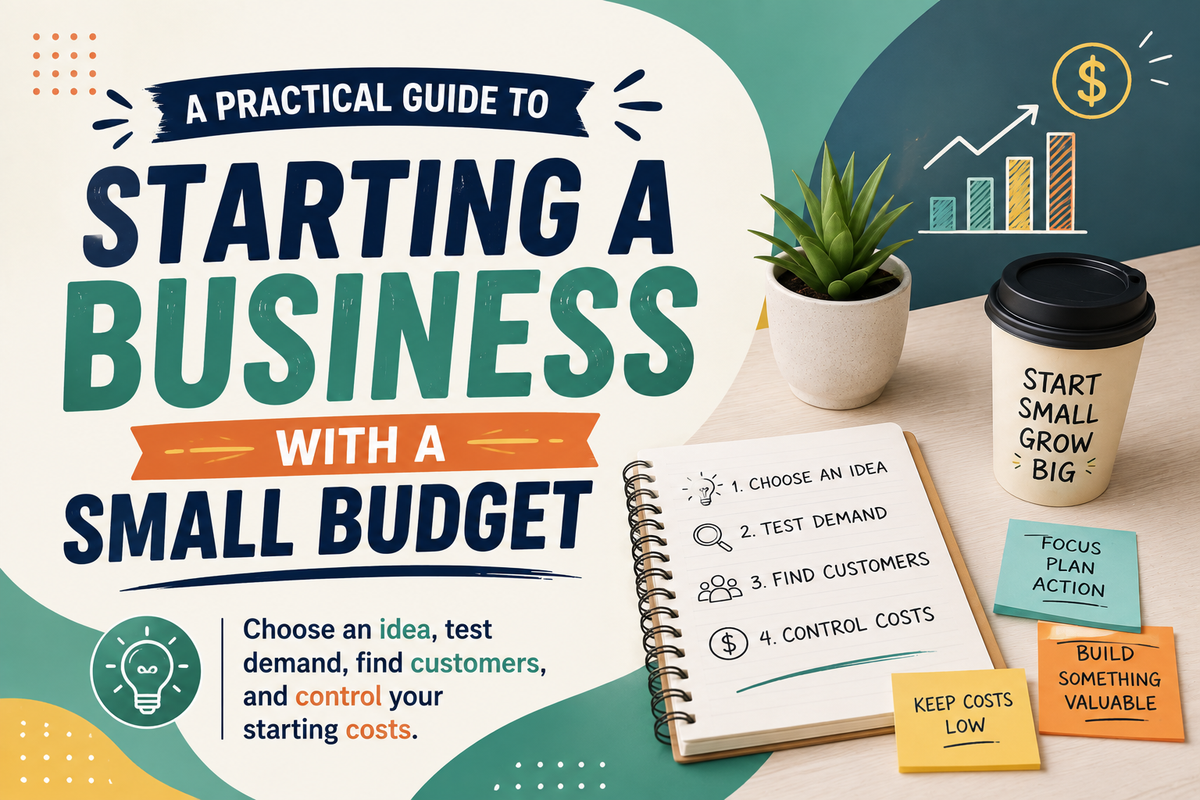
Choose an idea, test demand, find customers, and control your starting costs.
Here's the mistake that quietly kills most new businesses: people spend money first and check for customers later.
They buy the logo, the website, the inventory, the fancy tools - and only then discover whether anyone actually wants what they're selling. By the time reality shows up, the budget is gone.
You can flip that whole thing around. Starting lean isn't about being cheap - it's about doing the steps in the right order, so you never bet money on a guess. Here's the order.

🔴 STEP 1: CHOOSE AN IDEA YOU CAN ACTUALLY START Skip the "billion-dollar idea" pressure. Your first business just needs to solve a real problem for a specific group of people. Look at what you already know, what people ask you for help with, or what quietly frustrates you and others. Write it as one sentence: "I help [who] with [what]."
🔴 STEP 2: TEST DEMAND BEFORE YOU BUILD ANYTHING This is the step almost everyone skips. Before spending a cent, find out if people want it. Describe your offer to potential customers and watch their reaction. Better yet, ask them to pre-order, join a waitlist, or put down a small deposit. Interest is polite; money and commitment are proof.
🔴 STEP 3: FIND YOUR FIRST FEW CUSTOMERS BY HAND Forget big marketing at the start. Your first customers almost always come from people who already know you, or small communities where your ideal buyer hangs out. Reach out personally. Ten real conversations beat a thousand strangers scrolling past an ad.
🔴 STEP 4: CONTROL YOUR STARTING COSTS ON PURPOSE Use free or cheap tools until income justifies more. You do not need an office, custom software, or a big brand on day one. Keep your costs so low that even a slow start can't sink you - that's what buys you time to figure things out.
A LEAN STARTER CHECKLIST
Before you spend real money, make sure you can say yes to these:
- I can describe who I help and how, in one sentence
- At least a few real people have said they'd pay for it
- I know where my first ten customers will come from
- My monthly costs are low enough to survive a slow month
- I'm using free or cheap tools until income grows
If you can't check most of these yet, that's not a failure - it's a map of what to do next.
Here's the reassuring truth. Some of the most durable businesses started with almost no money and one paying customer. What they had wasn't capital - it was proof that someone wanted the thing before they scaled it. Get the proof first, and the money becomes a tool instead of a gamble.
5 CHEAP WAYS TO TEST DEMAND
Step 2 is the one everyone skips, so here are five ways to prove people want your idea without building anything:
- The pre-sale. Offer it before it exists and see if anyone pays or puts down a deposit. Money is the loudest yes there is.
- The waitlist. Put up a simple one-page description and collect emails from people who want in. Real sign-ups beat polite nods.
- The conversation. Talk to ten people in your target group and listen for "where can I buy this," not "that's a nice idea."
- The small test. Sell a tiny, manual version by hand to a few people before scaling anything up.
- The competitor check. If similar things already sell, that's not bad news - it's proof a market exists. Your job is to serve one slice of it better.
WHAT DEMAND ACTUALLY SOUNDS LIKE
╰┈➤ Be careful with fake signals. "That sounds great" is encouragement, not demand. "I'd definitely buy that" is closer, but still just words. Real demand looks like someone reaching for their wallet, joining a list, or asking when they can start.
Here's the fact that saves budgets: a large share of small businesses that fail do so because they built something people didn't actually want - not because the product was bad, but because nobody checked first. Get a few real yeses before you spend, and you skip the single most expensive mistake there is.
KEY TAKEAWAY: Starting a business on a small budget isn't about spending less - it's about proving demand before you spend at all. Nail down who you help, get a few real yeses, and keep your costs low enough to survive the learning curve.
❯❯❯❯ Ready to build something useful instead of just thinking about it? Take the first step here.
Prove it first. The money part gets a lot easier after that.
-AI Business Builder