
A Practical Guide to Working With a Smaller Team
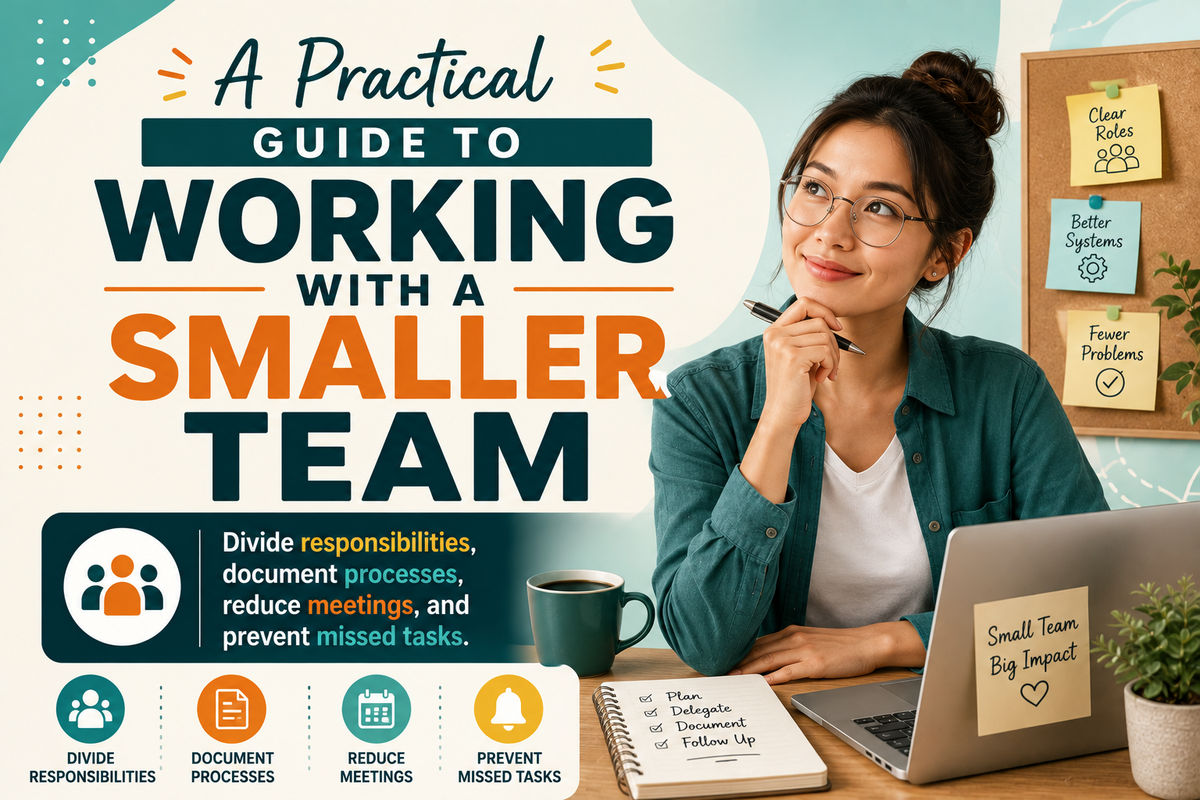
Divide responsibilities, document processes, reduce meetings, and prevent missed tasks.
There's a quiet myth that a small team is just a big team missing some people - understaffed, stretched thin, always behind.
That's the wrong way to see it. A small team is a different machine entirely, and a well-run one can move faster than a big company drowning in layers, meetings, and approvals. Speed is your advantage.
But small teams have their own traps. When they fall behind, it's rarely about size - it's about a few fixable problems. Let's fix each one.
🧩 PROBLEM: Nobody's sure who owns what.
FIX: Divide responsibilities clearly. On a small team, one fuzzy area means everyone assumes someone else has it - and nobody does. Give every important area a single clear owner. Not "we'll handle it," but "this is yours." Clarity here prevents most dropped balls before they happen.
📝 PROBLEM: The knowledge lives in people's heads.
FIX: Document your processes. When only one person knows how something's done, the whole team stops the moment they're out sick or busy. Write down how recurring tasks work, even roughly. A simple written process turns fragile knowledge into something anyone can pick up.
⏱️ PROBLEM: Meetings eat the time you don't have.
FIX: Reduce and tighten them. Small teams can't afford to lose hours to meetings that could have been a message. Before scheduling one, ask what decision it will make. For the ones worth having, keep them short, with a clear purpose and a captured next step.
📋 PROBLEM: Tasks slip through the cracks.
FIX: Make work visible in one place. When tasks live in scattered heads, texts, and inboxes, things get forgotten. Use one shared board or list where every task is visible with an owner and a due date. If it's on the board, it won't be forgotten.

⚡ PROTECT YOUR SPEED ADVANTAGE
Here's the thing to guard fiercely: your biggest edge over larger competitors is how fast you can move. A small team can decide today what a big one schedules a meeting about next month.
So don't accidentally copy big-company habits as you grow - the endless approvals, the meetings about meetings, the processes for the sake of process. Add just enough structure to stop things from slipping, and no more. The goal is a team that's organized and fast, not organized and slow.
Here's a fact worth holding onto: research on teams consistently finds that smaller groups communicate more easily and make decisions faster, because there are fewer connections to manage and less coordination overhead. Your size isn't the handicap. Used well, it's the whole point.
🔄 A SIMPLE OPERATING RHYTHM
Structure doesn't have to mean bureaucracy. A light weekly rhythm keeps a small team aligned without drowning it in process:
- A short weekly check-in to agree on the few things that matter this week. Not a status marathon - just priorities and blockers.
- A shared board everyone updates, so the check-in isn't spent reciting what's already visible.
- A quick end-of-week glance to catch anything about to slip before it does.
That's often all the "management" a small team needs: clarity on priorities, visibility of work, and a habit of catching problems early.
📚 THE DOCUMENTATION HABIT THAT SAVES YOU
The single highest-value habit for a small team is writing things down as you go. Every time someone figures out how to do a recurring task, capture it - even a rough list of steps. Over time you build a simple library of how your team works.
This is what lets a small team survive vacations, sick days, and new hires without everything grinding to a halt. Knowledge that lives only in one head is a risk; knowledge written down is an asset the whole team can use. Small teams that document quietly become far more resilient than their size suggests.
🔑 KEY TAKEAWAY
A small team isn't a weaker big team - it's a faster machine, if you run it right. Give every area one clear owner, document your processes, keep meetings rare and short, and make every task visible in one place.
╰┈➤ˎˊ˗ AI is changing how businesses work. Learn how to use it to create opportunities of your own.
Small and clear beats big and tangled. Keep it that way.
- AI Business Builder