From Zero to More Opportunities Than You Can Take — Real Success Guide
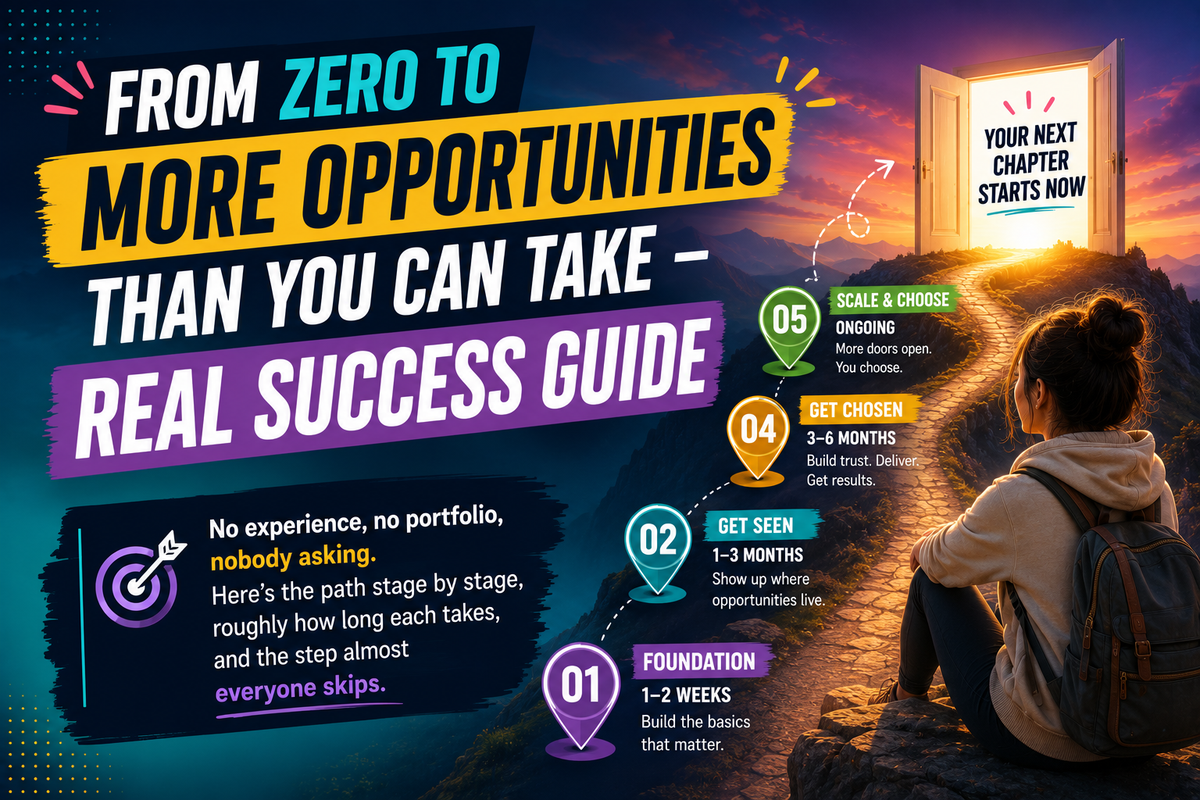
No experience, no portfolio, nobody asking. Here's the path stage by stage, roughly how long each takes, and the step almost everyone skips.
The question comes in some version of this: I've got no experience, no portfolio, and nobody asking me for anything. Where do I actually start?
It's a fair question, and the honest answer is that the distance from zero to opportunities arriving unprompted is much shorter than it looks.
The order is the part people get wrong.
Opportunities don't arrive because you're capable. They arrive because your capability is visible.
That's the whole mechanism. Most people spend a year quietly getting good and then wonder why nothing is happening.
Nothing is happening because nobody can see it. Skill nobody can point at doesn't produce work — it produces a private feeling of being underused.
Getting good is stage one of four. Almost everybody stops there and calls it bad luck.
The sequence. Run it in this order and it works. Run it out of order and it stalls.
Stage zero — pick one narrow thing. About a week. Not "learn AI." One specific use with a buyer attached: writing product descriptions, tidying messy spreadsheets, turning recorded meetings into notes, preparing images for listings. Narrow enough to say in one sentence.
Stage one — get one result you can describe. Two weeks. Do it for two people you already know, cheap or free, once each. You're not building a business yet. You're buying a sentence: I did this for them and it saved them that.
Stage two — make it visible. Starts week three, never stops. Write up what you did, plainly. The problem, what you changed, what happened afterwards. This is the step nearly everyone skips, and it's the one that converts skill into opportunity.
Stage three — charge for it. Week four onwards. Small, fixed price, one job. The first paid job changes the way you describe yourself, and that changes who takes you seriously.
Stage four — let it compound. Referrals coming from stage one, enquiries arriving from stage two, repeat work from stage three. Three sources running at once. This is the point where opportunities stop being something you chase and start being something you filter.
What separates the people who reach stage four from the ones who stall at one.
● Publish every result, however small. A hundred-word write-up of a small job beats a polished portfolio you never finish. Volume of visible proof is the actual engine.
● Stay narrow far longer than feels comfortable. Broadening early is the most common mistake. Narrow gets remembered; general gets forgotten.
● Describe what it's for, not what it is. "I clean up messy customer spreadsheets" lands. "AI-powered data solutions" does not.
● Ask everyone happy the same question. Who else do you know with this problem? One sentence, and it's where most of stage four comes from.
Honest timing: stage zero to stage three is about six weeks for people who do it in order. Stage four takes months, not weeks. Anyone promising nonstop opportunity by Friday is selling something — but the first paid job inside six weeks is entirely realistic.
Pick your narrow thing today and message two people this week. That's stages zero and one, and it's most of the difficulty.
❯❯❯❯ And if you want somewhere to publish the proof that does the work for you, here's the place
Nobody finds you because you got good. They find you because you left something behind.
— AI Business Builder