How One Freelancer Doubled Their Output Without Working Longer Days
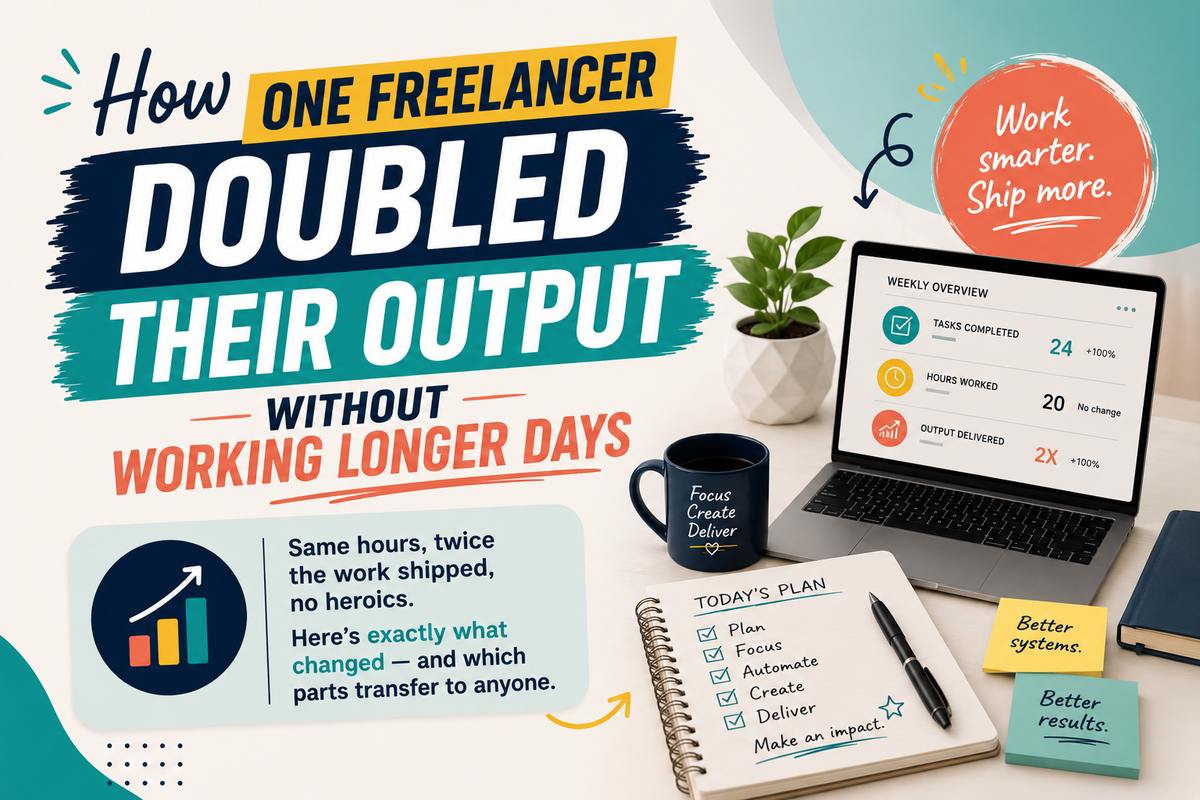
Same hours, twice the work shipped, no heroics. Here's exactly what changed — and which parts transfer to anyone.
Here's a version of a story I keep hearing, assembled from several people describing roughly the same six weeks.
A freelance copywriter, eight years in, permanently at capacity. Turning down work not because there wasn't demand, but because the days were already full.
The bottleneck was never the writing. It was everything around it.
Written down honestly, a typical week looked like this: eleven hours actually writing, and about nineteen hours of everything else.
Proposals. Research. Client updates. Revisions of things that were nearly right. Invoice chasing. Re-explaining the same process to every new client.
Almost nobody is limited by their actual craft. They're limited by the twenty hours of scaffolding around it.
What changed — four things, over six weeks.
Research stopped being a morning. Background reading on a client's industry went from three hours to about forty minutes: gather the material, get it summarised, then read properly only the parts that mattered.
Proposals became a template with real thinking in it. One good proposal saved as the example, new details pasted in, twenty minutes of genuine customisation on top. From three hours to forty minutes, and the win rate didn't drop.
First drafts stopped starting from nothing. Not written for her — structured. Brief in, outline out, then she wrote the actual thing. The blank page vanished and with it the two hours of circling it.
Client updates got automated into a rhythm. Same day each week, same short format, mostly assembled from work already logged.
The after. Roughly nineteen hours of scaffolding fell to about nine. The writing hours stayed exactly the same — that part was never the problem and was never touched.
The extra time went into two more clients, at a higher rate, because the proposals were now going out the same day the enquiry arrived.
What transfers, whatever you actually do.
● Measure the scaffolding, not the craft. Write down a week honestly. The ratio is almost always worse than people assume, and it's where the gains are.
● Attack the thing that delays the start. Proposals going out days late cost more work than any slow delivery ever did.
● Never automate the part clients are paying for. The writing stayed hers, deliberately. That's why the quality held and the rate went up rather than down.
● Give it six weeks, one change at a time. All four at once fails. One change per fortnight sticks.
Worth saying plainly: this wasn't a productivity system or a new app. It was four specific bottlenecks, found by writing down a week and looking at it honestly. That step is free and almost nobody does it.
Write down your week. Split it into the work you're paid for and the work around it. The ratio will tell you where your next ten hours are.
❯❯❯❯ And if you'd like to point those recovered hours at something of your own, here's the next step
Nobody is limited by the work itself. Only by everything stacked around it.
— AI Business Builder