How to Earn 3x Your Daily Wage in a Few Focused Hours — Simple Tips
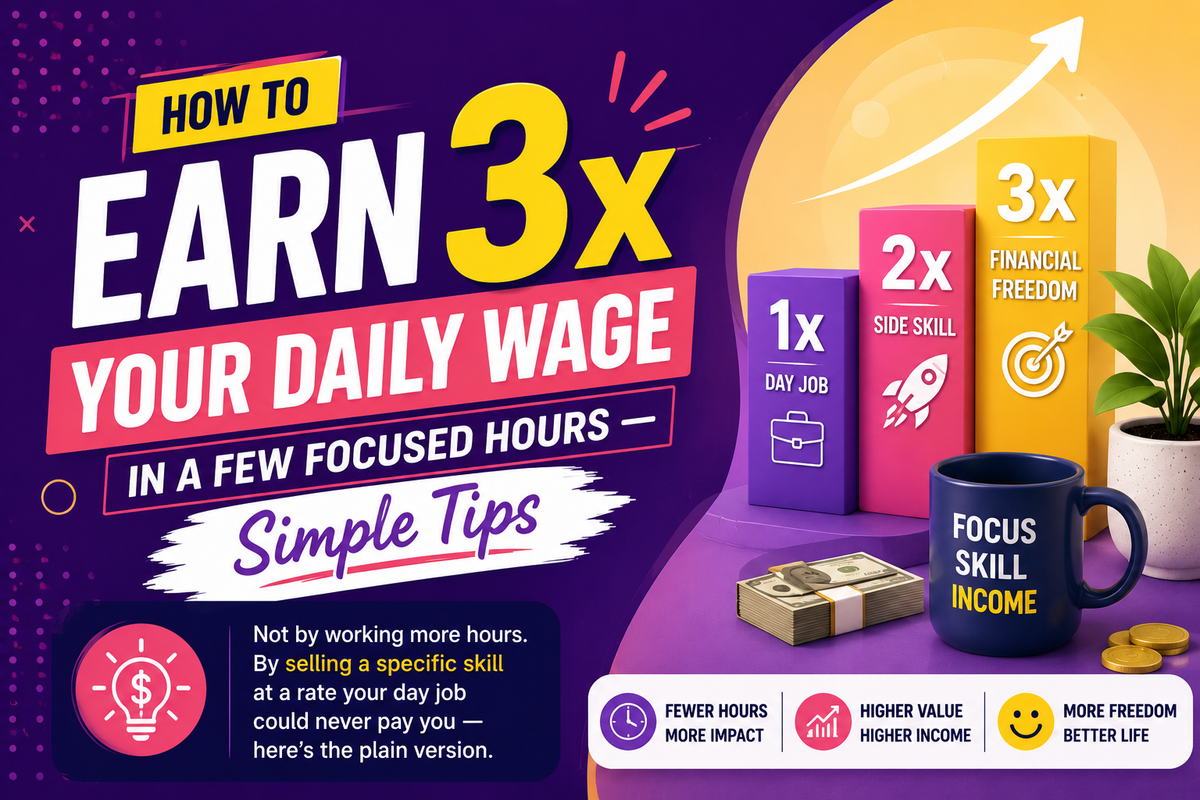
Not by working more hours. By selling a specific skill at a rate your day job could never pay you — here's the plain version.
Work out what an hour of your time earns at your job. Take the yearly figure, divide by the hours you actually give it.
Hold that number. Because the same skill, sold directly to someone who needs it, routinely earns three times as much per hour — and it has nothing to do with working harder.
A salary prices your hour once. Selling the skill directly prices it every time.
Inside a job, your rate is fixed and shared. The business takes the margin, covers the overhead, and pays you a slice. That's a fair deal for stability — but it caps what an hour can earn.
Sell the same skill straight to someone with the problem, and the margin the business used to keep is yours. That gap is where the three times comes from.
You're not learning a new skill to earn more. You're removing the middle that was pricing the one you have.
Why the number is realistic, not hype.
A business pays you for an hour and bills a client several times that for the same hour. You've seen the invoices. The multiple was always there — it just went to your employer.
When you do a defined job directly, in the evenings, with the boring parts handled by the tools now available to anyone, you keep it. Three times your day rate on those hours isn't a promise about your month. It's simply what the hour is worth once nobody's taking the margin.
The simple tips that make it real.
Sell a finished outcome, not your time. "£300 to clear the whole listing backlog" earns far more per hour than an hourly rate, and it stops punishing you for being fast.
Pick the skill your job already proves you have. No learning curve, no impostor feeling. You do it at work; you're qualified by definition.
Do the boring parts faster. The drafting, the formatting, the first pass. Cutting a six-hour job to two is what turns a normal rate into a multiple of it.

Four more tips that decide whether it works.
● Start slightly uncomfortable on price. If the number feels easy to say, it's too low. Raise it after five people pay without hesitating.
● Charge from the very first job. Free work attracts people who were never going to pay and teaches you nothing about your rate.
● Keep it to a few focused hours. This works because it's concentrated, not because it's long. Two good evening hours beat a scattered weekend.
● Let the day job fund the patience. The salary is what lets you decline bad clients and hold your price. That's a feature, not a compromise.
One honest note: three times your day rate is what those focused hours can be worth — it is not a claim that everyone triples their total income overnight. The first job might pay less while you find your feet. But the ceiling on directly-sold hours is genuinely far higher than the one your salary sets, and that gap is the whole opportunity.
Work out your hourly figure tonight, then write down one number three times higher for a defined job. That's the exercise — and the number will look more reasonable than you expect.
❯❯❯❯ And if you want somewhere to offer that skill properly rather than mentioning it in passing, start here
Your hour was never worth what your payslip said. That was just the price after everyone else took theirs.
— AI Business Builder