How to Test a Business Idea Before Spending Your Money
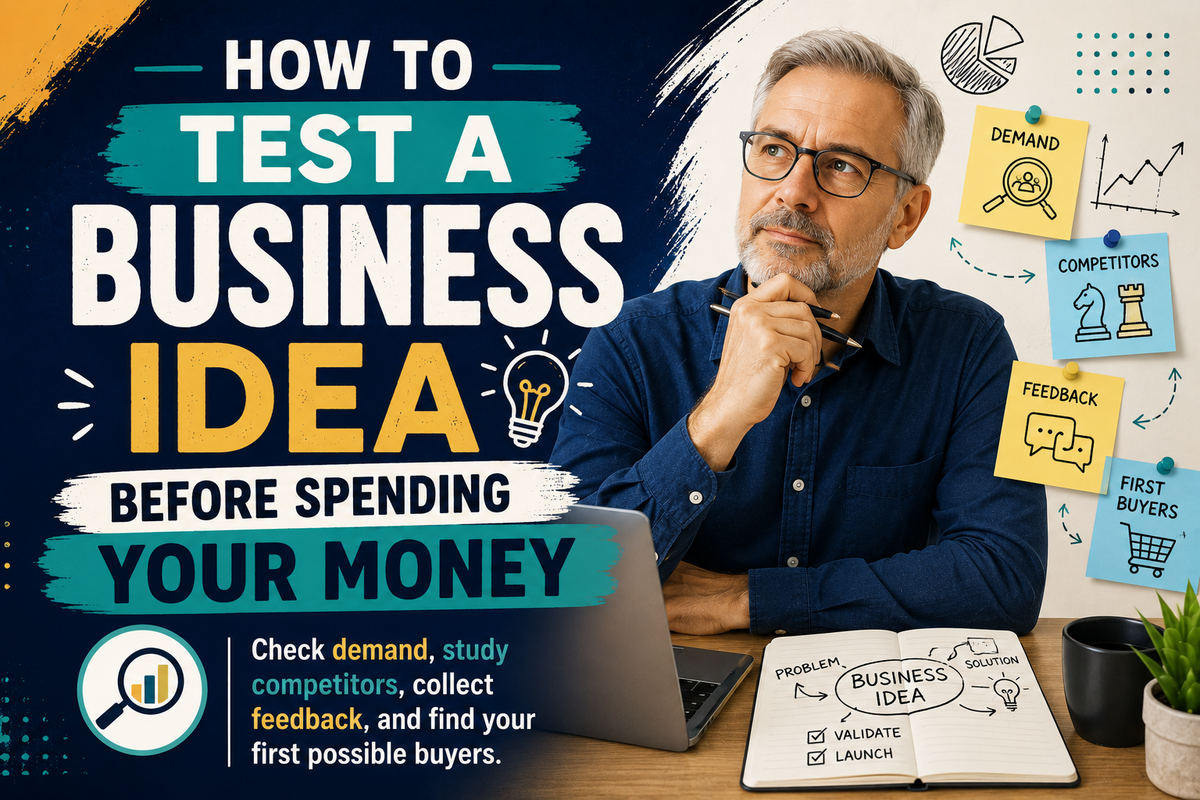
Check demand, study competitors, collect feedback, and find your first possible buyers.
Here's the most expensive mistake in business, and almost everyone makes it: they build the thing first and check for customers later.
They spend the money, the months, the energy - and only afterward discover whether anyone actually wanted it. By then, the budget's gone and the lesson is painfully expensive.
There's a much smarter order. Before you spend a cent, you test the idea. And testing an idea is faster, cheaper, and more revealing than most people think. Here's exactly how.
🔎 STEP 1: CHECK DEMAND FIRST
Demand is the one thing that decides everything, so prove it before anything else. Don't ask friends if your idea "sounds good" - that's just politeness. Instead, look for real signals: will people join a waitlist, put down a deposit, or pre-order? The strongest test is whether someone will commit before the thing even exists. Money and sign-ups are proof; nods and compliments are not.
📊 STEP 2: STUDY YOUR COMPETITORS
Some people panic when they find competitors. That's backwards. Existing competition is proof that a market exists and people already pay for it. Your job is to study them: what do customers praise, and where do they complain? Every common complaint about an existing option is a gap you could fill better. Read reviews, note the frustrations, and let them show you your opening.
💬 STEP 3: COLLECT REAL FEEDBACK
Now talk to actual people in your target group - ten good conversations beat a hundred guesses. Describe the problem you solve and listen closely. You're not fishing for praise; you're listening for "where can I get this" versus "that's nice." Ask what they use today, what annoys them about it, and what they'd happily pay to fix.
🎯 STEP 4: FIND YOUR FIRST POSSIBLE BUYERS
Finally, identify where your first handful of customers will actually come from. Not "everyone" - a specific, reachable group. Often it's people who already know you, or a small community where your ideal buyer already gathers. If you can name where the first ten will come from, you have a real starting point, not just a hope.
A QUICK WORKED EXAMPLE
Say your idea is a meal-planning service for busy parents. Here's the test in action.
Demand: you post a simple one-page description and offer a free first week to anyone who joins a waitlist. Forty parents sign up in a few days. That's a signal.
Competitors: you find a few similar services and read their reviews. The loudest complaint? They ignore food allergies. That's your opening.
Feedback: you talk to ten of those waitlisted parents. Eight of them mention the exact same struggle. Now you know precisely what to build first.
First buyers: those forty parents, plus the local parenting group they came from, are your first market. You haven't spent real money yet - and you already know the idea has legs and exactly how to shape it.
That's the whole point. Testing doesn't slow you down. It aims you, so the money you eventually spend goes toward something you already know people want.

SIGNALS TO TRUST, SIGNALS TO IGNORE
As you test, learn to read feedback honestly - because it's easy to hear only what you want to hear:
- Trust: someone pre-orders, joins a waitlist, or asks "when can I buy this?"
- Trust: people describe the problem back to you with real frustration
- Ignore: "that's a great idea," with no action behind it
- Ignore: praise from friends and family who just want to be supportive
- Ignore: your own excitement - it's fuel, not evidence
The rule of thumb: watch what people do, not just what they say. Actions cost something; compliments are free.
CHEAP TOOLS MAKE TESTING EASY
╰┈➤ The best part is how little a real test costs today. A simple one-page site to describe your offer, a form to collect sign-ups, and a few honest conversations are often all you need to learn whether an idea has legs. You can validate most ideas in a week or two for almost nothing - long before you commit real money, time, or your reputation to building the full thing.
❯❯❯❯ Put AI to work for your goals, uncover new ways to create value, and build a business that can grow with your skills and experience.
KEY TAKEAWAY: The most expensive mistake in business is building something nobody wanted. Before you spend, prove demand with real commitments, study competitor complaints for your opening, gather honest feedback, and name where your first ten buyers will come from.
Prove it first. Everything after that gets a whole lot less risky.
- AI Business Builder