Skills That Get More Valuable When Machines Can Write
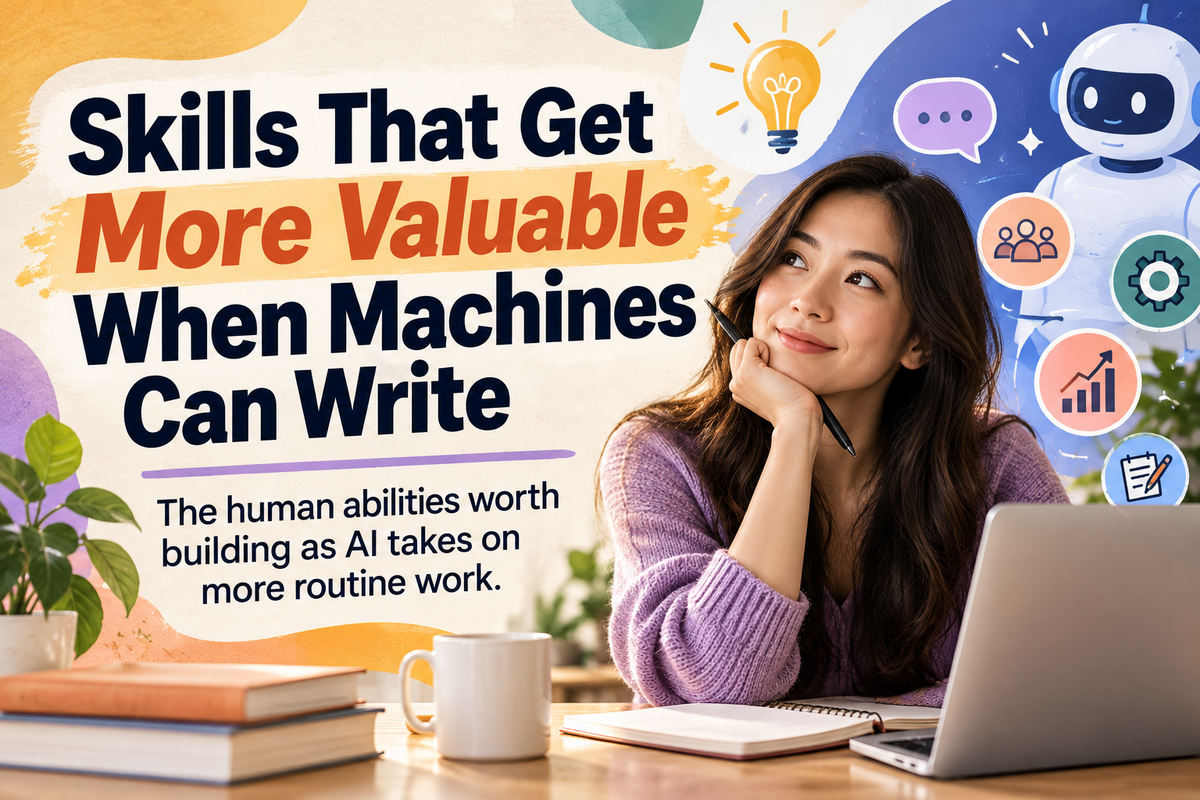
The human abilities worth building as AI takes on more routine work.
When calculators became cheap and common, arithmetic didn't stop mattering.
But the valuable skill shifted. It became less about doing the sums by hand and more about knowing which sums to do, and noticing when an answer looked wrong.
Something similar is happening now with writing, research, and many everyday office tasks.
🧭 WHAT BECOMES MORE VALUABLE
AI can now produce a decent first draft of an email, a report, a summary, or a plan in seconds. That makes the act of producing a first draft less special.
What becomes more valuable is everything around the draft.
Judgment. Knowing what good looks like, and noticing when something is off. AI can produce ten options. Someone still has to pick the right one.
Asking good questions. The quality of AI output depends heavily on the quality of the request. Clear thinking about what you actually need is a real skill.
Checking and editing. Spotting errors, gaps, and weak reasoning is more important than ever, because confident-sounding mistakes are easy to produce.
Understanding people. Building relationships, handling difficult conversations, reading what a client really needs, and earning trust.
Knowing your field. Deep knowledge of an industry, a customer type, or a craft gives you context that general tools lack.
Combining tools into systems. Knowing how to connect AI, automation, and people into a workflow that actually works.
None of these are brand-new skills. They're long-standing professional skills, and they're becoming the main differentiator.
━━━━━━━━━━━━━━━━━━━━
🎯 USE AI TO PRACTICE, NOT JUST PRODUCE
AI can also help you build these skills.
Use it as a practice partner. Ask it to role-play a difficult client so you can rehearse a tough conversation.
Ask it to critique your writing and explain its suggestions. Ask it to quiz you on a topic you're learning.
You can also use it to learn faster.
Ask for a beginner-friendly explanation of a new concept in your field, then ask follow-up questions until it clicks, and confirm key facts with reliable sources.
📈 BUILD SKILLS THAT LAST
1. Edit more than you generate Use AI drafts as practice material for sharpening your editing eye.
2. Get specific about your field Deep knowledge in a specific area is harder to replace than general skills.
3. Practice the hard conversations Negotiating, giving feedback, and handling complaints are skills that improve with rehearsal.
4. Learn one workflow tool Basic automation skills are useful in almost any job.
5. Stay curious Try new tools on real tasks, but focus on what they change about your work, not just the novelty.
🚀 A SIMPLE WAY TO START
Pick one skill from the list above that you'd like to strengthen.
This week, use an AI assistant to practice it once. For example, ask it to play a client pushing back on your price, and practice your response.
Afterward, ask it for feedback on how you handled it.
❯❯❯❯ Looking for courses that combine human skills with smart use of AI tools? Discover options worth considering.
📌 NOTE
There's a lot of confident talk about which jobs and skills will matter in the future. Nobody knows exactly.
Focus on skills that are useful today and likely to stay useful, and treat bold predictions with healthy skepticism.
KEY TAKEAWAY ⤵
When drafts get easy, judgment gets valuable.
Pick one human skill and practice it with AI this week.
The machine writes the draft. Your judgment makes it worth reading.
- AI Business Builder