Small Shops, Big-Company Habits
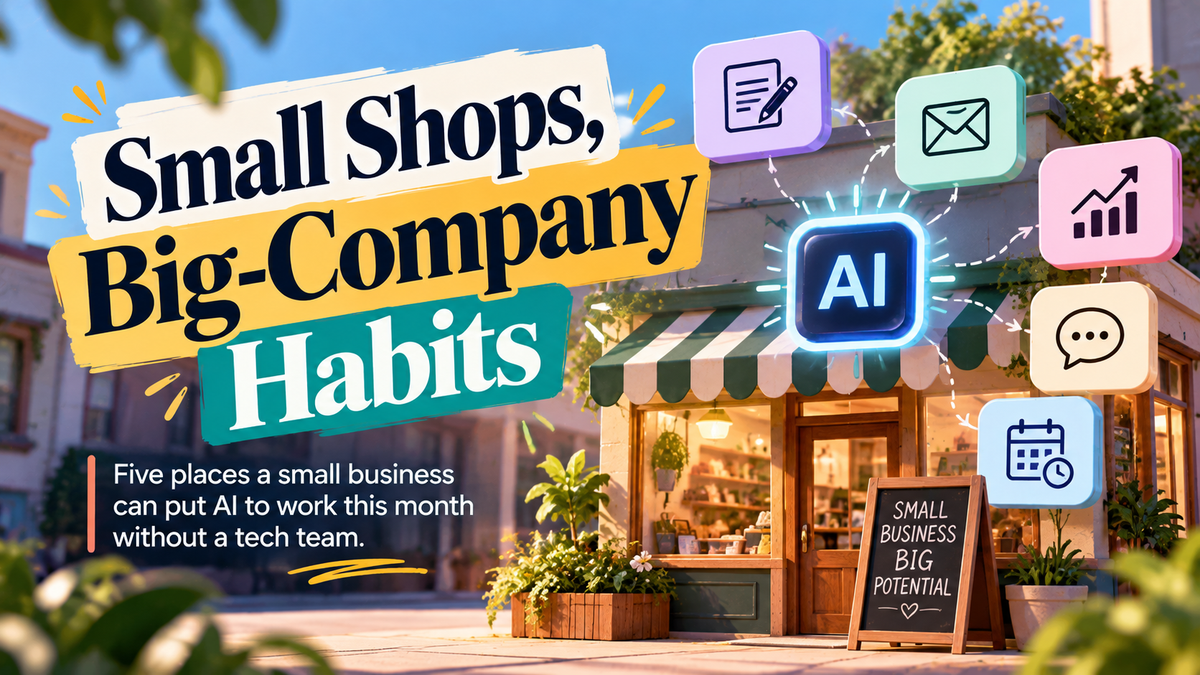
Five places a small business can put AI to work this month without a tech team.
Big companies have marketing departments, customer service teams, analysts, and assistants.
A small business often has one person doing all of those jobs before lunch.
That gap used to be very hard to close. Today, everyday AI tools can cover a surprising amount of it.
🏪 FIVE PLACES TO START
One advantage small businesses have is speed. There's no committee to approve a new tool and no long rollout.
If something saves time on Tuesday, you can be using it on Wednesday.
The trick is to start where the payoff is clear, rather than trying to "do AI" everywhere at once.
Here are five places where small businesses often see value first.
1. Writing everyday content. Product descriptions, social posts, website updates, and newsletters. AI produces the first draft, and you add your knowledge and your voice.
2. Customer messages. Drafting replies, building an FAQ, and keeping answers consistent, as we covered on October 4.
3. Making sense of reviews. Paste in a batch of customer reviews, with names removed, and ask AI what people praise most and complain about most. Patterns jump out quickly.
4. Planning and scheduling. Turning a messy list of to-dos into a weekly plan, or drafting a staff schedule template you then adjust.
5. Learning on demand. Asking AI to explain a tax term, a marketing concept, or a software feature in plain language, then confirming key details with a reliable source.
🥖 WHAT THIS LOOKS LIKE IN REAL LIFE
Picture a small bakery owner.
Each week, she spends time writing posts about new items, answering the same questions about custom orders, and guessing which products to make more of.
With an AI assistant, she drafts a week of posts in one sitting. A saved FAQ handles custom-order questions.
And asking AI to summarize a month of reviews shows that customers keep mentioning one particular bread, which tells her what to promote.
None of this replaces her skill as a baker. It gives her back time to use it. (This is an illustrative example, not a specific business.)
📋 KEEP IT SMALL AND PERSONAL
1. Pick one area, not five Choose the one that costs you the most time each week and start there.
2. Use what you already have Many tools you already pay for, like email, office software, and design apps, now include AI features. Check before buying something new.
3. Set a time limit for testing Give a new approach two weeks. If it isn't saving time by then, adjust or drop it.
4. Keep your personality in it Customers choose small businesses partly for the human touch. Use AI for drafts, not for your voice.
🚀 A SIMPLE WAY TO START
Choose one of the five areas above that fits your business best.
This week, use an AI assistant for that task three times. Note how long it took compared with doing it the old way.
That small experiment will tell you more than any article can.
❯❯❯❯ Looking for affordable resources built for small teams? Discover options worth trying.
📌 NOTE
Small businesses often handle customer information with fewer formal policies than large companies.
Before pasting in emails, reviews, or customer lists, remove names, contact details, and order information.
It's a simple habit that protects your customers and your reputation.
KEY TAKEAWAY ⤵
Small businesses can move fast, and that's a real advantage. Pick one area, test it three times this week, and measure the time saved.
Small and quick can beat big and slow.
- AI Business Builder