
The Repetitive Work Quietly Eating Your Week and How to Hand It Off
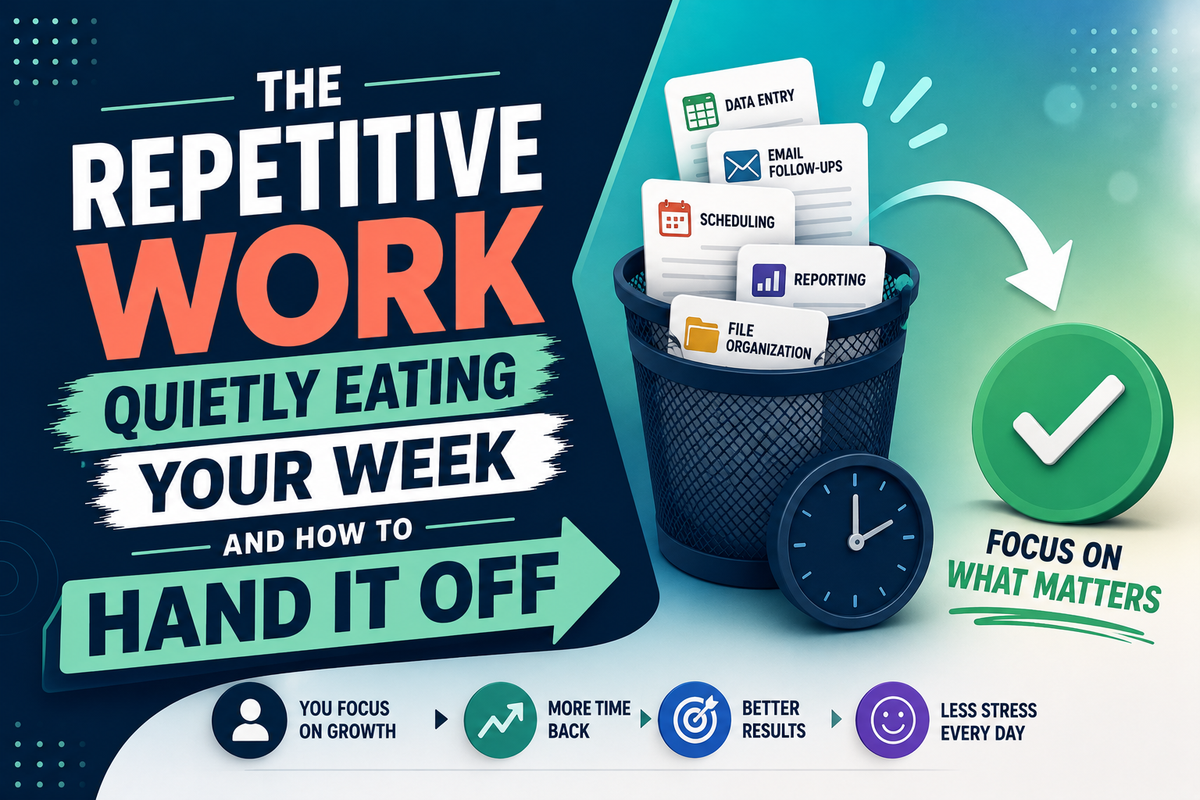
Every business has three or four tasks that never needed a human. Here's how to find yours and stop doing them by hand.
Ask most people where their week went and they'll name a big project.
Look at the actual calendar and it's almost never the big project. It's forty minutes chasing an invoice. An hour rebuilding a report that gets rebuilt every month. Ninety minutes writing four versions of the same update.
None of that is hard work. That's exactly why it survives.
Hard work gets planned for. Small repetitive work slips through unnoticed, week after week, because each individual instance is too small to complain about.
Nobody ever decided to spend six hours a week on this. It accumulated while nobody was counting.
Here's how to find yours.
Keep a running list for one week. Three columns and nothing more: what the task was, roughly how many minutes it took, and whether anyone would notice if it were done a different way.
A notes file is enough. The only requirement is that it lives outside your head.
At the end of the week, sort every line into one of four buckets.
Keep. Only you can do it, and your judgment is the product.
Batch. Small things that cost more in switching than in doing. Gather them into one sitting.
Template. Anything you've written or built a version of before. Write it once properly and fill in blanks forever.
Hand off. Repeated, rule-shaped, no judgment in the middle. This is the bucket worth attacking first.

Now the part that decides whether any of this sticks.
Pick one task. Not five.
● Choose the one you dread. The job that gets pushed to Friday afternoon every single week. That reluctance is the most reliable signal you own.
● Write down exactly how you do it now. Every step, in order, as if explaining it to someone new. If you can't write it, you can't hand it over — to a person or to anything else.
● Hand off the steps with no judgment in them. The sorting, the copying, the reminding, the reformatting. Keep the decisions.
● Leave it alone for two weeks before touching the next one. Systems that get changed constantly never get trusted.
The mistake almost everyone makes is trying to fix all of it at once. That's how people end up fixing none of it — one task, done properly, beats five started.
Open a note today and start logging. By Friday you'll know what your Mondays are actually made of.
❯❯❯❯ And if you want the complete setup rather than piecing it together yourself, here's where to look
The hours don't disappear. They just leave without telling you.
— AI Business Builder