The Side Hustle Follow-Up Nobody Writes
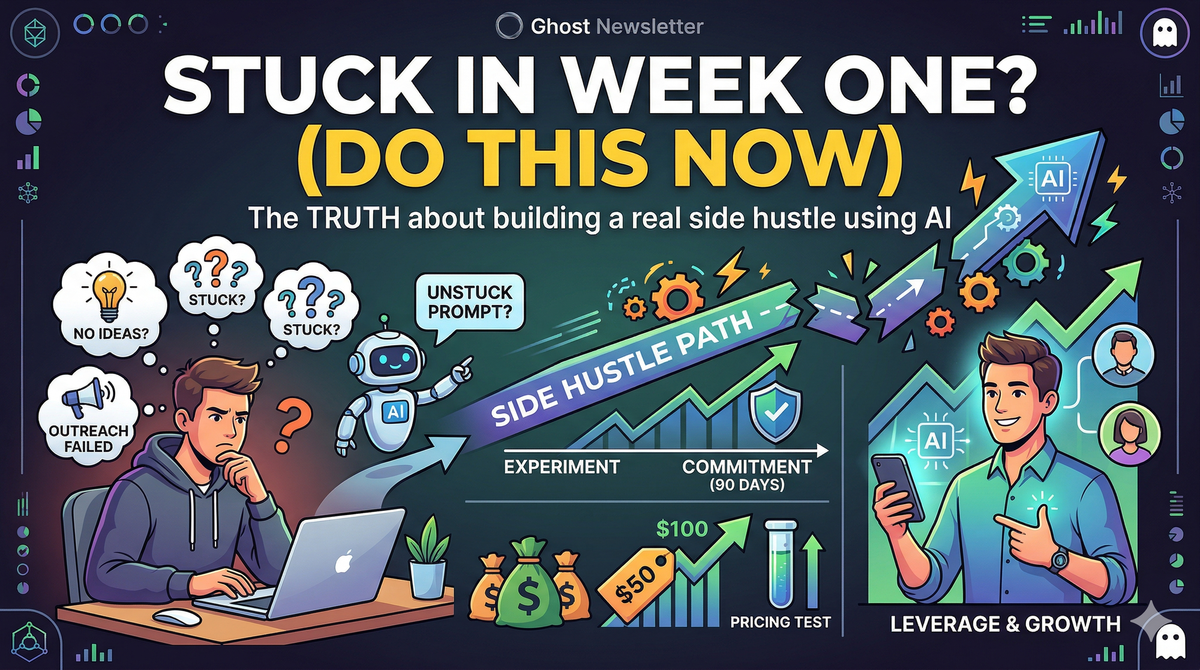
Hey,
In the last post we covered how to find your side hustle idea, turn it into a real offer, and land your first client — all using AI tools that cost nothing and require zero technical knowledge.
Today I want to go one level deeper.
Because starting is one thing. What happens in the days and weeks after you start is where most people quietly fall apart — not because the idea was wrong or the market wasn't there, but because nobody prepared them for the reality of what building something new actually feels like.
So let's talk about that. Honestly.
What Week One Actually Looks Like
Most people expect week one to feel exciting and momentum-filled. Sometimes it does. More often it feels like this:
You send the twenty outreach messages. Three people respond. One of them is actually interested. You have a conversation. They say they need to think about it.
And then you sit there wondering if the whole thing was a bad idea.
It wasn't. That experience is not failure — it's the process working exactly as it should.
Here's what's actually happening in week one: you are collecting data. Every message you send, every response you get, every conversation you have is telling you something about your offer, your audience, and your positioning. The goal of week one is not to make money. The goal is to have real conversations with real people and learn what resonates.
The money comes from applying what those conversations teach you.
The One Thing That Separates People Who Make It From People Who Don't
It is not talent. It is not the quality of their idea. It is not timing or luck or connections.
It is this: they treated their side hustle like a commitment rather than an experiment.
An experiment you abandon when results don't come quickly. A commitment you show up to regardless — because you've decided in advance that the outcome is worth the discomfort of the early stages.
Make that decision now, before you need to make it under pressure. Decide that you are doing this for ninety days regardless of how week one or week two or week three feels.
Ninety days of consistent action produces results that one week of motivated action never can.
How to Use AI When You're Stuck
There will be moments — probably multiple times a week in the beginning — where you simply don't know what to do next. The path feels unclear. The momentum has stalled. The blank page is back.
This is where most people waste hours on research, comparison, and overthinking. Here's the faster approach.
Open ChatGPT and describe the specific situation you're stuck in:
"I'm building a [type of side hustle]. I've done [what you've done so far]. The problem I'm hitting right now is [describe it specifically]. What are three concrete things I could do in the next 24 hours to move forward?"
Read the three suggestions. Pick the one that feels most actionable right now. Do that one thing.
That's it. Not a strategy overhaul. Not a pivot. Just the next one thing, identified in two minutes, executed today.
Progress in a side hustle is almost never one big breakthrough. It's a series of small next steps taken consistently enough that they eventually compound into something significant.
AI is exceptional at helping you find the next small step when you can't see it yourself.
The Pricing Conversation You Need to Have With Yourself
At some point in the first few weeks, you will wonder if you're charging the right amount. Almost certainly you'll be tempted to charge less than you should.
The logic feels sound: lower price means easier yes, easier yes means more clients, more clients means more revenue. In practice, this logic is backwards.
Underpricing does three things that all work against you.
First, it attracts clients who are primarily motivated by price — which means they'll be the most demanding, least satisfied, and most likely to ask for more than they paid for.
Second, it signals lower quality. Price is a proxy for value in the buyer's mind. A suspiciously cheap service raises questions about why it's so cheap.
Third, it makes your side hustle unsustainable. You end up working more hours than the income justifies, burning out, and concluding the whole thing wasn't worth it — when the real problem was the pricing.
Here's a simple test: take what you're currently charging and double it. Does the new number feel uncomfortable? Good. That discomfort is usually the gap between what you believe you're worth and what you're actually worth to the right client.
You don't need to double your price today. But you do need to take the question seriously.
When to Bring AI Deeper Into Your Work
Once you've landed your first one or two clients and you're getting comfortable with the basic workflow, this is when AI starts to become genuinely powerful rather than just useful.
Here's what that looks like in practice.
For service-based side hustles: Start using AI not just to help you deliver the work but to systematise how you deliver it. Ask ChatGPT to help you create a repeatable process for each type of task you do — a checklist, a template, a step-by-step workflow. The goal is to eventually deliver the same quality of work in half the time, which either doubles your effective hourly rate or frees up time to take on more clients.
For digital products: Start using AI to expand your product range. One PDF guide becomes a template pack. The template pack becomes a mini-course. The mini-course becomes a community. Each product you add serves the same audience more deeply and earns revenue without additional client work.
For both: Use AI to handle every piece of communication you repeat regularly. Proposal templates, client onboarding emails, progress update messages, invoice follow-ups — all of it drafted in seconds. The administrative friction of running a side hustle drops dramatically when AI handles the repetitive writing.
The pattern is consistent: the more deliberately you use AI as a business tool rather than just a writing assistant, the more leverage you create — and leverage is ultimately what turns a side hustle into something that works for you rather than the other way around.
A Note on Comparison
At some point you will come across someone doing what you're doing who appears to be further ahead, more polished, more successful, or more confident than you feel right now.
When that happens, remember this.
You are seeing their output. You are not seeing their process. You are not seeing the months of uncertainty before things clicked. You are not seeing the clients who said no, the offers that didn't land, the weeks that felt exactly like yours feel right now.
Every person further along in this journey was exactly where you are at some point. The only difference between them and the people who never got started is that they stayed in the process long enough for it to work.
Your job right now is not to be as far along as someone else. Your job is to be further along than you were last week.
That is the only comparison that produces useful information.
This Week
Three things. That's all.
One: Send ten more outreach messages. Not the same twenty from last week — ten new ones. Keep the pipeline moving even before the first one converts.
Two: Deliver something this week that makes a client or potential client think — unprompted — that was better than I expected. Exceed one expectation this week. That moment is where reputation begins.
Three: Open ChatGPT and use the stuck-prompt above for whatever is currently blocking you. Not tomorrow. Tonight.
Small actions. Consistent execution. Longer timeline than you'd like.
That's the whole strategy. And it works every time it's actually followed.
See you next week.
PJ