
Vague Requests Get Vague Answers
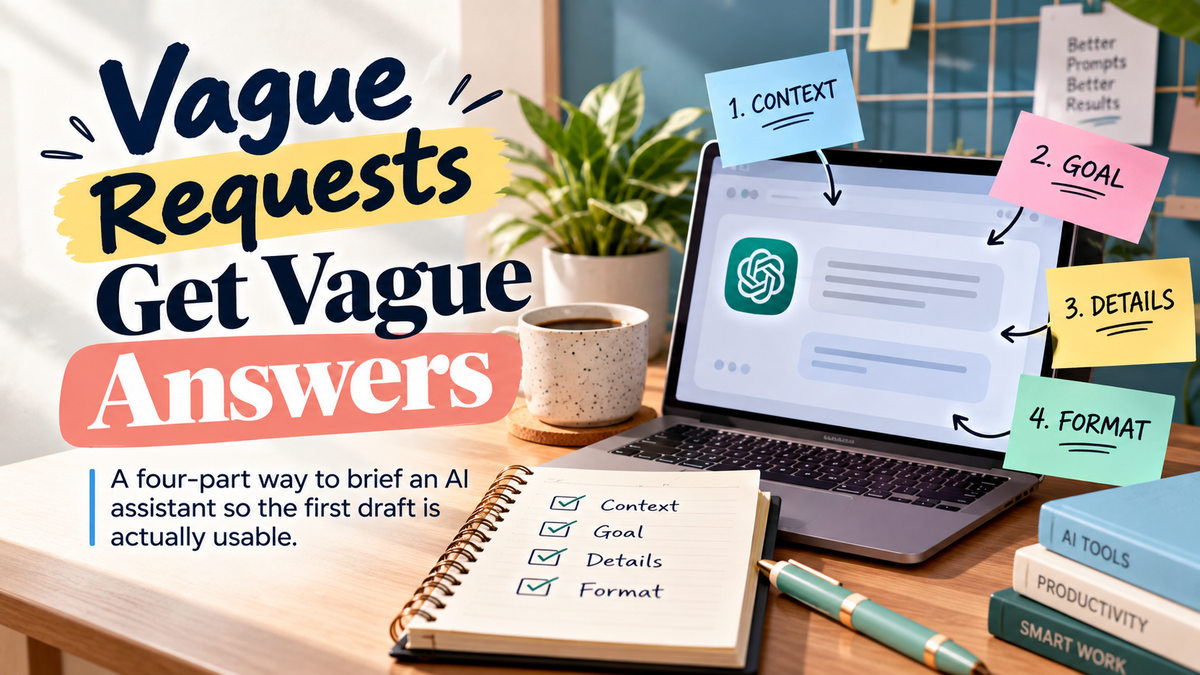
A four-part way to brief an AI assistant so the first draft is actually usable.
Ask a new employee to "write something about our services" and you'll get something generic.
Not because they're bad at the job, but because you didn't tell them who it's for, what it's for, or what good looks like.
AI assistants work the same way. Most disappointing results come from short, vague requests.
📝 A PROMPT IS JUST A GOOD BRIEF
The instruction you give an AI tool is often called a prompt. There's a lot of mystery around "prompt writing," but at its heart it's just giving a good brief.
Think of how you'd hand a task to a capable freelancer who has never met you.
You'd tell them the goal, give them background, explain the format you need, and mention anything to avoid.
That translates into a simple four-part structure.
1. The task. What exactly do you want? "Write a short product description."
2. The context. Who is it for, and what should they know? "For a handmade soy candle, sold online to people buying gifts. Scent is cedar and orange."
3. The format. How long, what style, what shape? "Under 80 words, warm tone, one short paragraph."
4. The guardrails. What to avoid or include? "Don't use the words 'luxurious' or 'indulge.' Mention it burns for about 40 hours." (Only include details you know are true.)
Put together, that's a prompt anyone can write, and it gets a far better first draft than "write a candle description."
⏱️ WHY A CLEAR BRIEF SAVES TIME
A clear brief does more than improve one answer. It saves the back-and-forth.
Instead of five rounds of "no, shorter," "no, friendlier," "no, not like that," you often get something close on the first try. That's where real time savings come from.
You can also reuse good prompts. Once you've written a brief that works for your product descriptions, save it. Next time, you only swap in the new details.

🎯 SMALL TWEAKS, BETTER DRAFTS
1. Give an example when you can Pasting in a piece you like and saying "match this style" works remarkably well.
2. Tell it who to be "You're an experienced editor" or "act as a patient tutor" can shift the tone and focus.
3. Ask for options "Give me three versions" lets you pick the best direction quickly.
4. Ask it to ask you If you're unsure what to include, end with "ask me any questions you need before writing." It will often spot gaps you missed.
🚀 A SIMPLE WAY TO START
Take something you asked an AI tool recently that came back disappointing.
Rewrite your request using all four parts: task, context, format, and guardrails. Run it again and compare the two results side by side.
Save the better prompt in a note called "Prompts that work."
❯❯❯❯ Want better results from the AI tools you already use? Learn simple techniques that make a difference.
📌 NOTE
A well-written prompt improves the writing, not the facts.
If you ask for a product description and the AI adds a feature your product doesn't have, it's still wrong.
Give it accurate details, and remove anything it adds that you can't stand behind.
KEY TAKEAWAY ⤵
Task, context, format, guardrails. Four short parts turn a vague request into a usable first draft.
A clear request is half the answer.
- AI Business Builder