When a Confident Answer Is Completely Wrong
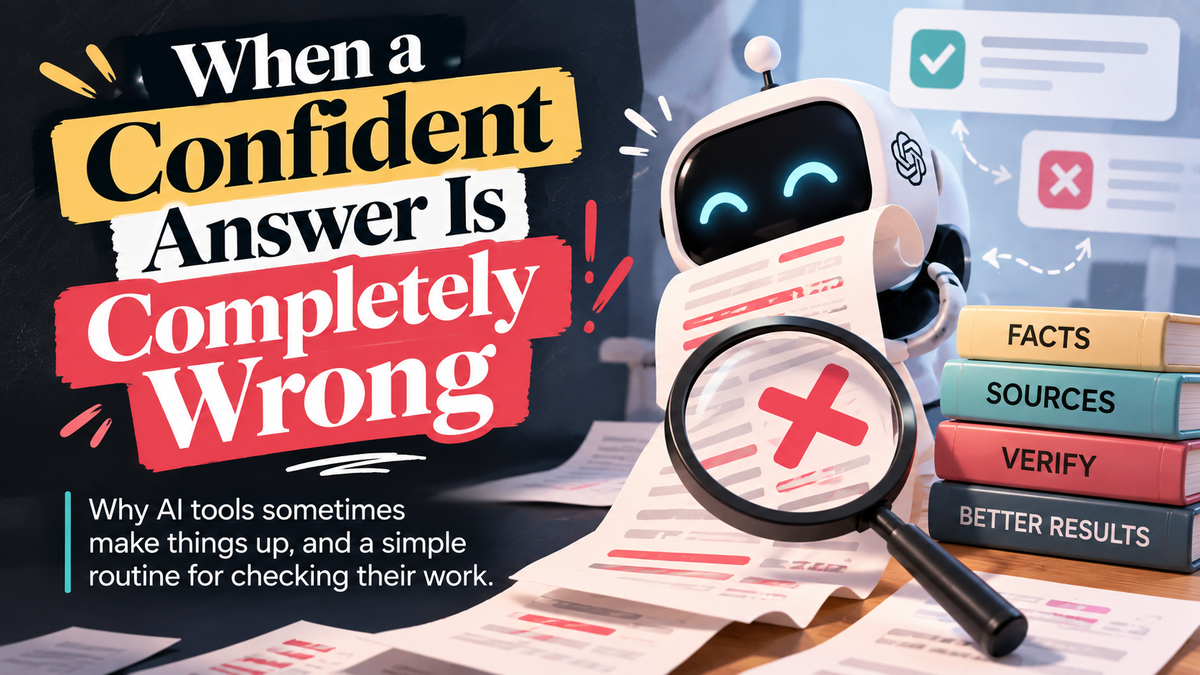
Why AI tools sometimes make things up, and a simple routine for checking their work.
Ask an AI assistant for a book recommendation, and it might give you a title, an author, and a neat one-line summary.
Sometimes, that book doesn't exist.
There's no warning, no hesitation, and no change in tone. The answer reads exactly like a correct one.
⚠️ WHERE MISTAKES TEND TO HIDE
This happens often enough that it has a name: hallucination. It means the AI produces information that sounds right but isn't true.
As we covered on October 2, AI assistants write by predicting what text should come next. They're very good at producing the shape of a correct answer.
But producing the shape isn't the same as checking the facts.
Hallucinations tend to show up in predictable places.
√ Specific details. Names, dates, prices, statistics, and quotes.
√ Sources and references. Links, book titles, studies, and legal cases that may be partly or completely invented.
√ Niche topics. Subjects where there was less written material for the model to learn from.
√ Recent events. Anything that happened after the tool's knowledge ends, unless it's using live web search.
The risk isn't that AI is always wrong. It's often right. The risk is that you can't tell from the tone which answers are which.
━━━━━━━━━━━━━━━━━━━━
🛡️ USE IT FOR WHAT IT DOES WELL
The goal isn't to stop using AI. It's to use it for what it's reliably good at, and to add a quick check where accuracy matters.
AI is dependable for structure, wording, summarizing material you provide, and generating ideas. It's less dependable as a source of facts on its own.
Some tools now include web search and show the sources they used. That's helpful, because you can click through and confirm. But a source link only helps if you open it.
🔎 A QUICK CHECKING ROUTINE
1. Sort answers by risk A brainstorm of blog titles needs no fact-check. A number going into a client report does.
2. Give it your own material Summarizing a document you paste in is much more reliable than asking it to recall facts from memory.
3. Ask for sources, then open them Make sure the link exists and actually says what the AI claims.
4. Ask it to flag uncertainty Adding "tell me if you're unsure about any part of this" often brings weak spots to the surface.
5. Use a second check for anything important An official website, a trusted reference, or a qualified person.
🚀 A SIMPLE WAY TO START
Next time you use AI for something factual, run a quick three-step check.
Underline every specific fact in the answer: names, numbers, dates, and claims. Pick the two that matter most and confirm them from a reliable source.
If either turns out wrong, treat the rest of the answer with extra care.
❯❯❯❯ Looking for tools that show their sources so checking is easier? Take a look here.
📌 NOTE
Be especially careful with legal, medical, financial, and safety information.
AI can be a useful way to understand a topic, but decisions in these areas should be confirmed with official sources or a qualified professional.
KEY TAKEAWAY ⤵
An AI's confident tone never tells you whether it's right. Sort answers by risk, and check the facts that matter before you use them.
Trust the draft, but verify the facts.
- AI Business Builder